
Introduction
Artificial Intelligence (AI) is changing the way people work, learn, and run businesses. One of the biggest reasons for this transformation is the rapid growth of AI tools. These tools help automate tasks, improve productivity, create content, analyze data, and solve complex problems in just a few minutes.
Whether you’re a student, business owner, freelancer, marketer, or content creator, AI tools can save time, reduce costs, and improve the quality of your work. In this guide, you’ll learn what AI tools are, how they work, their benefits, the most popular AI tools in 2026, and how to choose the right one for your needs.
What Are AI Tools?
AI tools are software applications powered by artificial intelligence that perform tasks that normally require human intelligence. They use technologies such as machine learning, natural language processing (NLP), and computer vision to understand information, make decisions, and generate results.
These tools can:
- Write articles and emails
- Generate images
- Edit videos
- Create presentations
- Analyze data
- Translate languages
- Answer questions
- Write computer code
- Automate repetitive tasks
Today, millions of individuals and businesses rely on AI tools to work faster and more efficiently.
How Do AI Tools Work?
Most AI tools are trained using large amounts of data. They recognize patterns, understand user requests, and generate useful responses based on what they have learned.
For example:
- An AI writing tool can create blog posts from a simple prompt.
- An AI image generator can turn text into realistic artwork.
- An AI coding assistant can suggest code and fix programming errors.
The more accurate your instructions (often called prompts), the better the results.
Benefits of Using AI Tools
Using AI tools offers many advantages for individuals and businesses.
1. Save Time
AI automates repetitive tasks, allowing you to focus on more important work.
2. Increase Productivity
You can complete projects much faster with AI assistance.
3. Reduce Costs
Businesses can automate certain tasks instead of hiring additional staff for routine work.
4. Improve Creativity
AI helps generate new ideas for articles, videos, designs, and marketing campaigns.
5. Better Decision-Making
Some AI tools analyze data and provide insights to support smarter business decisions.
Types of AI Tools
There are many different categories of AI tools, each designed for specific tasks.
1. AI Writing Tools
These tools help create written content such as:
- Blog posts
- Emails
- Product descriptions
- Social media captions
- Marketing copy
They are widely used by writers, bloggers, and marketers.
2. AI Image Generation Tools
These tools create images from text prompts.
They can produce:
- Logos
- Illustrations
- Website graphics
- Social media images
- Marketing materials
Graphic designers and content creators use them to save time and generate creative visuals.
3. AI Video Tools
AI-powered video tools help users:
- Edit videos
- Generate subtitles
- Create AI avatars
- Produce short-form content
- Convert text into videos
These tools are especially useful for YouTubers and social media creators.
4. AI Coding Tools
Developers use AI coding assistants to:
- Write code
- Find bugs
- Explain programming concepts
- Improve software development speed
They support many programming languages and can significantly increase coding efficiency.
5. AI Productivity Tools
These tools help organize work by:
- Managing tasks
- Scheduling meetings
- Summarizing documents
- Taking meeting notes
- Automating workflows
They are popular among remote workers and business teams.
Best AI Tools in 2026
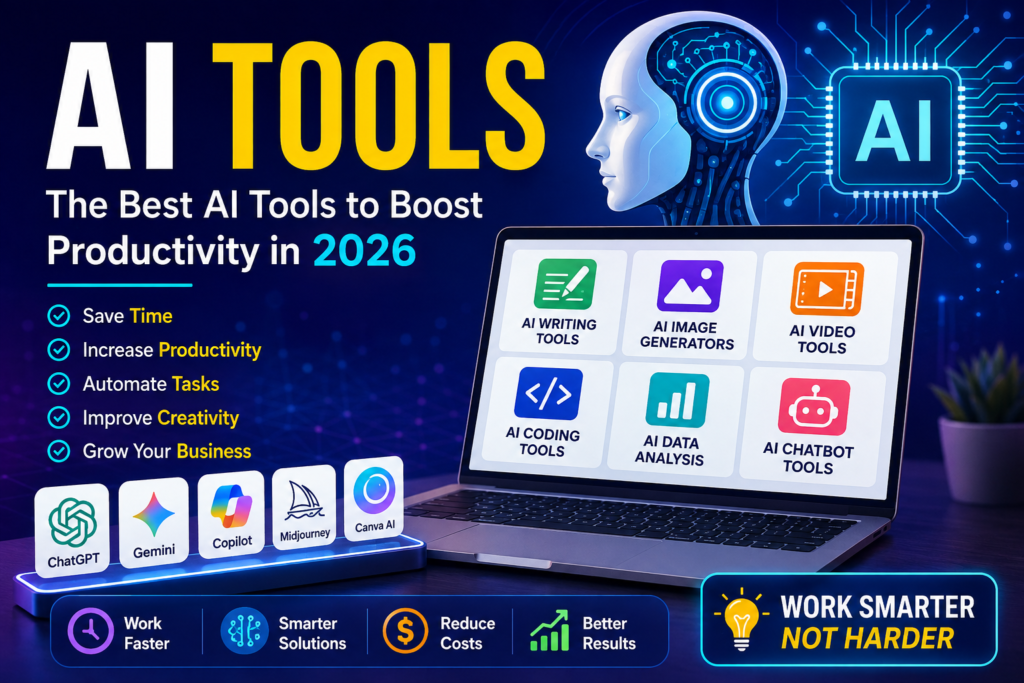
The AI industry continues to evolve rapidly. Some of the most widely used AI tools in 2026 include:
ChatGPT
A conversational AI assistant for writing, brainstorming, coding, learning, and problem-solving.
Google Gemini
An AI assistant integrated with Google’s ecosystem for productivity, research, and content creation.
Microsoft Copilot
Designed to help users work more efficiently in Microsoft Office and Windows applications.
Claude
Known for generating high-quality long-form writing, analysis, and research.
Canva AI
Helps users create professional graphics, presentations, and marketing materials with AI-powered design features.
How Businesses Use AI Tools
Businesses use AI tools in many different ways, including:
Customer Support
AI chatbots answer customer questions 24/7.
Marketing
AI creates advertising copy, email campaigns, and social media posts.
Data Analysis
Businesses analyze customer behavior and sales trends.
Sales
AI helps generate leads and personalize customer interactions.
Human Resources
Companies use AI to screen resumes and improve hiring processes.
How Students Use AI Tools
Students use AI to:
- Summarize notes
- Explain difficult topics
- Practice new languages
- Improve writing
- Solve math problems
- Organize study schedules
AI should be used as a learning assistant rather than a replacement for critical thinking.
Tips for Choosing the Right AI Tools
Before selecting an AI tool, consider the following:
Identify Your Goal
Choose a tool designed for your specific task, such as writing, design, coding, or video editing.
Compare Features
Review what each tool offers before making a decision.
Check Pricing
Many AI tools offer free plans alongside premium subscriptions.
Ease of Use
Select tools with user-friendly interfaces and good documentation.
Security and Privacy
Choose reputable providers that protect your personal and business data.
Challenges of AI Tools
Although AI tools offer many benefits, they also have limitations.
Some challenges include:
- AI may generate inaccurate information.
- Human review is still necessary.
- Some advanced features require paid subscriptions.
- Privacy concerns exist when uploading sensitive data.
- AI cannot fully replace human creativity and judgment.
Using AI responsibly helps reduce these risks.
The Future of AI Tools
The future of AI tools looks promising. As technology advances, AI systems are expected to become:
- More accurate
- Faster
- Easier to use
- Better at understanding human language
- More personalized
- More integrated into everyday software
AI will likely become a standard part of education, business, healthcare, finance, and many other industries.
Frequently Asked Questions (FAQ)
What are AI tools?
AI tools are software applications that use artificial intelligence to automate tasks such as writing, designing, coding, analyzing data, and creating content.
Are AI tools free?
Many AI tools offer free versions with limited features, while premium plans provide advanced capabilities.
Who can use AI tools?
Anyone can use AI tools, including students, freelancers, entrepreneurs, marketers, developers, teachers, and business owners.
Can AI tools replace humans?
AI tools are designed to assist people, not replace them. Human creativity, judgment, and decision-making remain essential.
Conclusion
AI tools have become an essential part of modern work and everyday life. They help individuals and businesses save time, improve productivity, and complete tasks more efficiently. Whether you need help with writing, coding, designing, marketing, or managing projects, there is likely an AI tool that fits your needs.
As AI technology continues to evolve, learning how to use AI tools effectively will become an increasingly valuable skill. Start by exploring a few trusted tools, practice using them regularly, and combine AI assistance with your own expertise to achieve the best results.